It’s an honour to have been included in the latest New Writing Scotland anthology, published each year by the Association of Scottish Literary Studies.
The anthology is a wonderful mix of poetry and prose by writers resident in or connected to Scotland. My contribution is a non-fiction piece about a trip to Assynt a couple of years ago. It’s called ‘Three Men in Assynt’. If you want to read it and the others, you can order the book (print only) here: https://asls.org.uk/publications/books/newwriting/nws44/
I don’t generally write much non-fiction, but here’s a bit more, travelogue style, about a trip to Egypt earlier this summer.
* * *
Cairo: Image and Experience
There are so many countries in the world that I’ve never been to. And yet, for plenty of them, if I were to go, I would have some notion of what to expect, based on people I’ve met, or news, books, films and music that I’ve absorbed.
I still remember watching on TV the vast crowds at the Tahrir Square protests in January 2011, when Egypt’s part in the Arab Spring seemed to erupt spontaneously from Tunisia’s uprising.
Then came the slow crushing of those seeds of hope, which I registered piecemeal, if at all, as Egypt gradually faded from my mind.
It was only when I read Basma Abdel Aziz’s brilliant 2016 dystopian novel The Queue, that it hit home what the country had undergone in those years. The Queue takes place in the aftermath of a fictionalised version of Egypt’s last large-scale civil disobedience, after the military coup that brought Abdel Fatah El-Sisi to power in 2013. On August 14th of that year, security forces killed over a thousand protestors when they broke up a peaceful occupation.
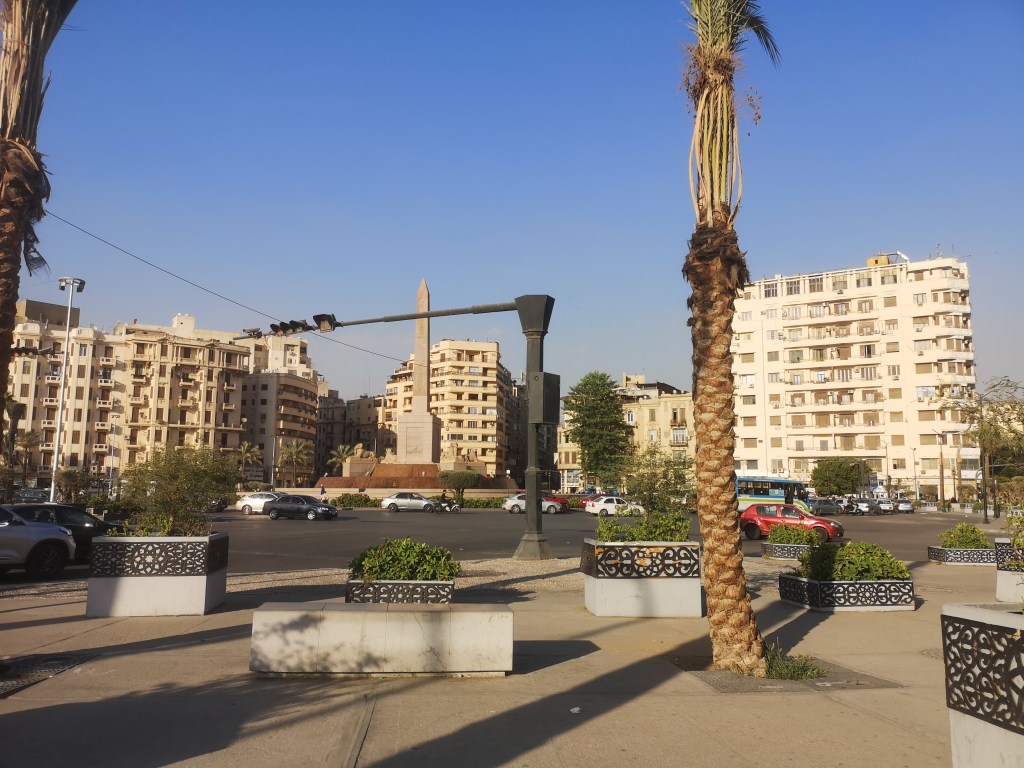
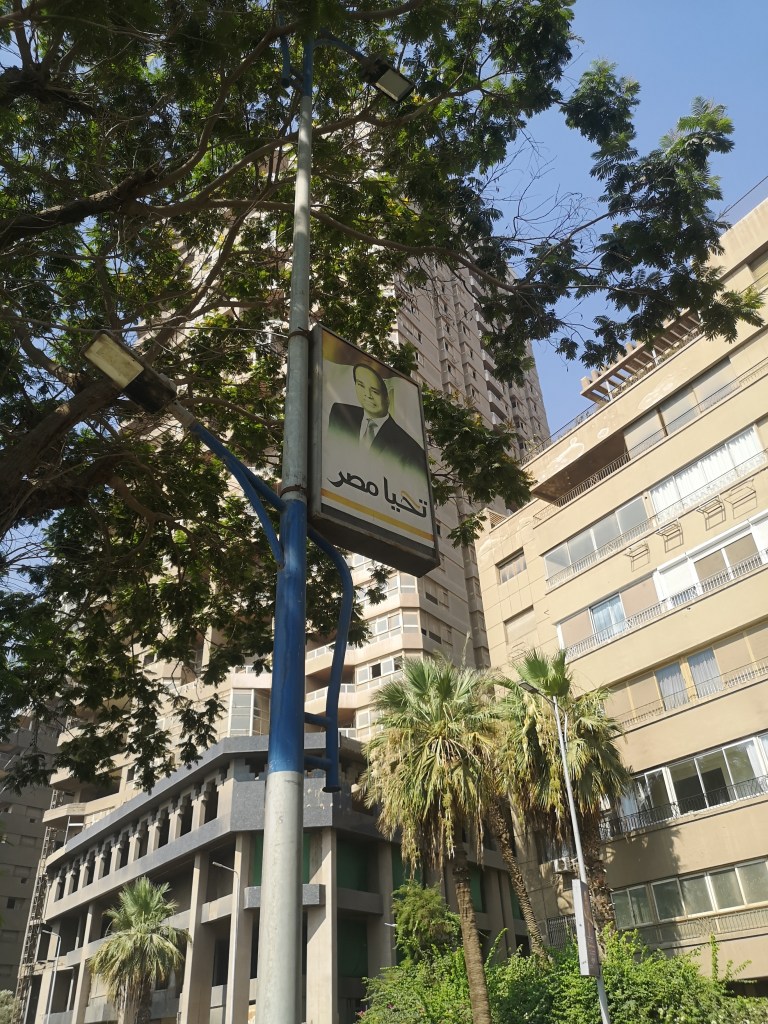
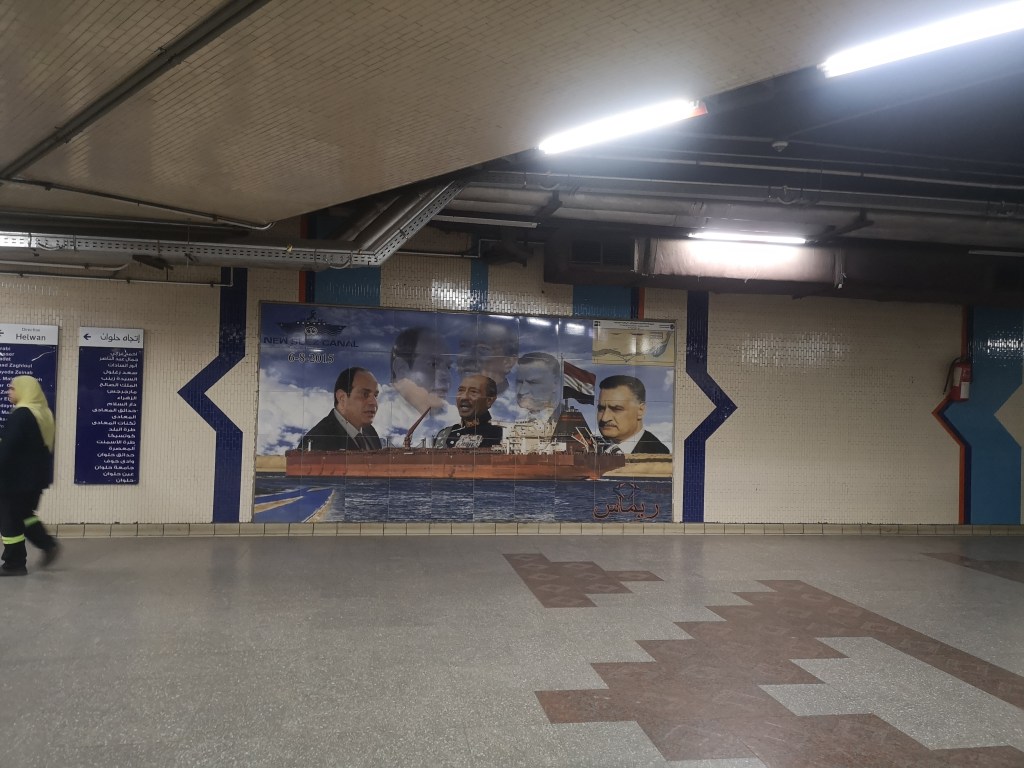
The Cairo I saw with my twelve year old daughter was absolutely the city that Abdel Aziz wrote about (without ever naming) in The Queue. My plan to see the site of the occupation and massacre, Rabaa Al Adawiyya Square in the eastern suburbs, proved pragmatically impossible. What we did see however, was Tahrir Square as it is today: all graffiti from the 2011 protests erased, an ancient Egyptian obelisk chosen as the square’s new centre-piece. Wherever we went in the city, Sisi’s face beamed down paternally at us from billboards and murals. His portrait was hung dutifully on the walls of shops, cafes and restaurants. Unsurprisingly, the pharaohs are a favourite source of his iconography: there was one recurring image of him with the sphinx just over his shoulder. Textbook propaganda: 1984, Egypt-style.
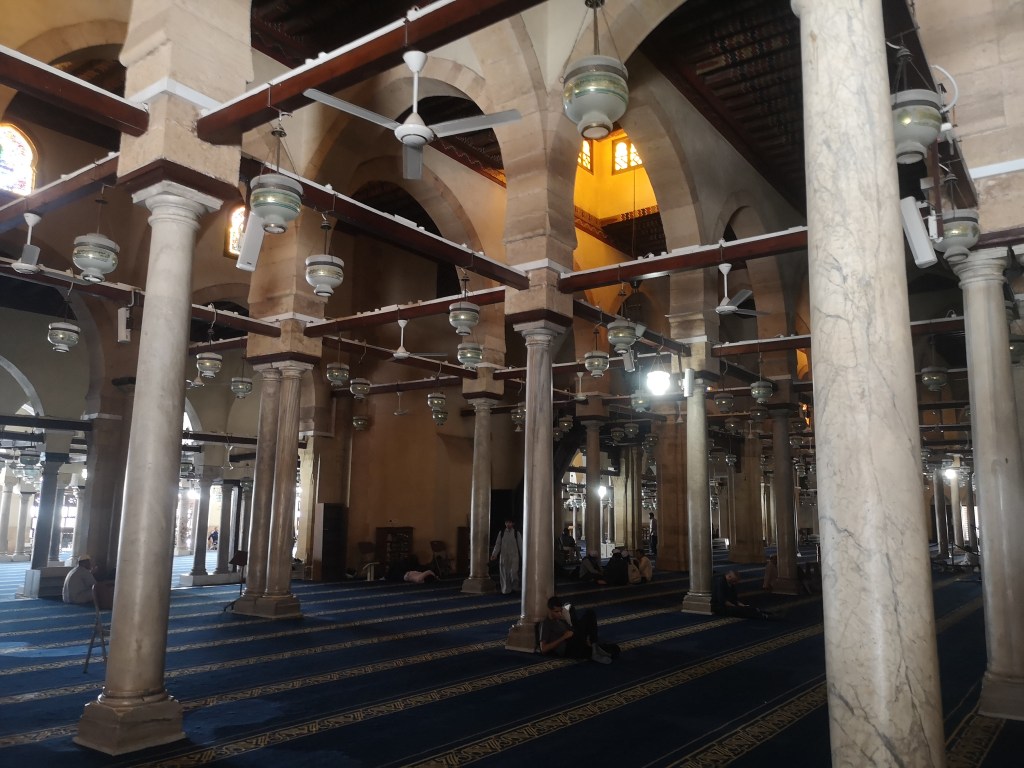
Another aspect of Cairo which Basma Abdel Aziz had prepared me for was the struggle of many Cairenes to scrape a living. Not that knowing this really helps when so many children are begging you to buy little packs of tissues or snacks that it would be impossible to give something to them all. This sense of a constant, cruel battle for economic survival is there in The Queue, and in her other novel, Here is a Body, which is also about the tension between Islam and the secular political power’s efforts to control it. So too is the film ‘The Cairo Conspiracy’, by the exiled director Tarik Saleh, set around the Al-Azhar mosque. Under the thousand year old arched colonnades we found welcome respite from the heat and desperate commerce of the streets. My daughter, in a borrowed headscarf, sat against a pillar and read some of her novel about her favourite victim of a megalomaniac ruler, Anne Boleyn.
Then it was back onto the streets and a five minute walk to another spot on my trail of literary Cairo. Happily this would prove an equal hit with my sometimes demanding companion. It was the Naguib Mahfouz cafe, named after the legendary Nobel-prize winning author, the third part of whose Cairo Trilogy was my reading material on our trip.
… to be continued
 T.Y. Garner Writer