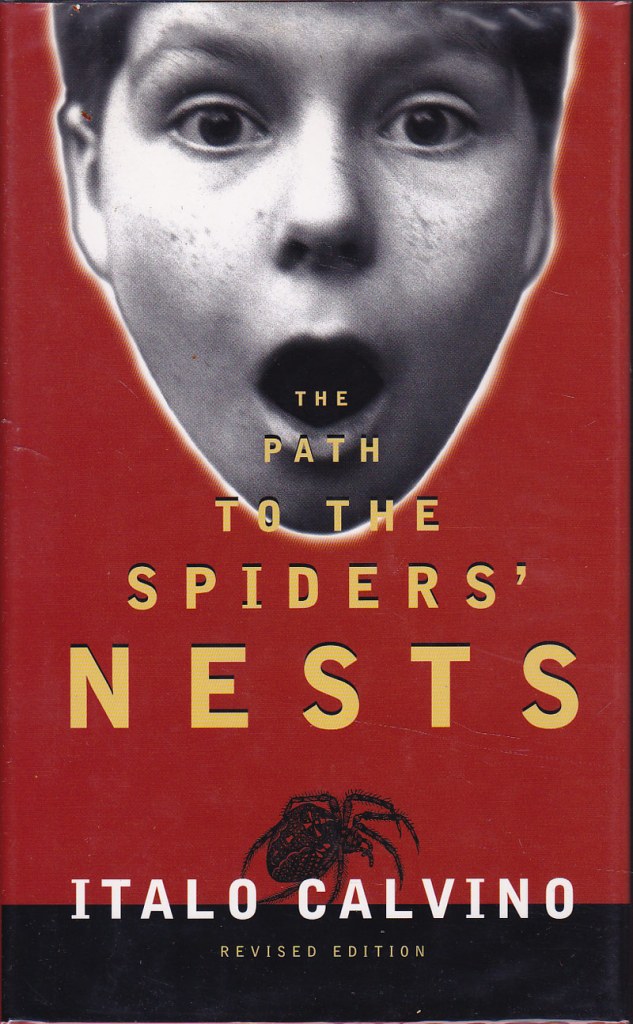
I can’t remember too much about what happens in Italo Calvino’s first novel The Path to the Spiders’ Nests. Only that its protagonist was a young boy caught up in the activities of Italian anti-fascist partisans in World War 2, and I enjoyed it.
What made it significant for me as a reading experience is that it was one of the first novels I read, out of choice, in a foreign language: Il Sentiero ai Nidi dei Ragni. Although I was studying Italian on the side of my undergraduate Eng Lit degree, this book wasn’t on the reading list and I didn’t have to invest hours on it, dictionary by my side. But I chose to, skimping instead on the convoluted essays about literary theory which I was supposed to be reading for English. I was coming to an understanding that foreign languages (at that time, Italian but later also Japanese) would open up a whole new way for me to experience the world, something none of the complicated literary theories seemed to offer.
I’ve come back to Calvino in the last year, in translation and in Italian, and now I see that his later work, more than perhaps any other fiction writer, chimes with the ideas of some of the key theorists I studied in Eng Lit. This is made explicit in Calvino’s collected non-fiction essays, Collection of Sand, which I’ve just been reading. In one of these he engages directly with the work of Roland Barthes, writing after the legendary French theorist died in a car accident near Paris in 1980.
The aspect of Barthes’ thinking with which Calvino engages most is his philosophy of images. This coincides with a key theme of The Hotel Hokusai, and to my delight, I discovered Calvino too was fascinated by Japan: a whole section of Collection of Sand is composed of essays he wrote during a short visit there in the 70s. Reading these, I recognised many of the same experiences that I had on my first visits to the country, where the extraordinary differences with anywhere else I had been before struck me most intensely. Calvino explains the reason for this:
“Seeing means perceiving differences, and as soon as differences all become uniform in what is predictable and everyday, our gaze merely runs over a smooth surface devoid of anything to catch hold of”
In the essay from which this quote is taken ‘The Old Woman in the Purple Kimono’, Calvino observes an old woman and a girl travelling in his carriage on the bullet train to Kyoto. He picks up on every tiny visual detail of the scene, and describes his own growing frustration with his inability to work out the nature of the relationship between them:
“It is at times like this that one feels the difference between two cultures, when one does not know how to define what one sees, the gestures and behaviours, when one is not able to tell what is usual and what is individual in them, what is normal and what is unusual.”
I recognised my own feelings and frustrations on my first visits to Japan, but thought that now, even with my not particularly brilliant Japanese, I would have understood enough of what they were saying to draw inferences about their relationship, rather than relying on purely visual cues as Calvino did. Certainly, I would have concentrated on the language, straining my ears to make out words I knew and guess at others. This made me think: maybe the purest visual response to a place comes from someone who is completely new to it, and doesn’t have a linguistic awareness. However, would this visual interpretation ever tell the whole story? This is a question which Calvino himself frets over in another essay about a guided tour of gardens in the aristocratic villas of Kyoto :
“…one finds oneself wondering whether this aesthetic and moral ideal of the bare and unadorned was achievable only at the peak of authority and wealth, and whether it presupposed other houses chock-full of people and tools and junk and rubbish, with the smell of frying, sweat, sleep, houses full of bad moods, people rushing, places where people shelled peas, sliced fish, darned socks, washed sheets, emptied bed pans.”
My fictional socialist painter, Archie Nith, in Japan for a year in 1893, wonders the same thing as Calvino in the 1970s. He is frustrated by his dealer’s demand for Japanese-themed art that fits the criteria of ‘simplicity, innocence and restraint’. This dichotomy, between a surface image of Japan as artefact, and a grittier human layer behind it, is something I try to explore in The Hotel Hokusai. I hope Calvino would have approved, and forgiven me my insertion of a boy’s close encounter with a spider on a forest path, which I may have written in subconscious homage to one of my favourite writers in any language.
 T.Y. Garner Writer