In the aftermath of revolution in North Africa in 2011, a migration crisis thrust the Italian island of Lampedusa into the international media spotlight. As a student journalist dreaming of a job as a foreign correspondent, I went there with photographer Eva Barton to report (all photo credits below belong to Eva). On our return I pitched the following long-form article to all the national newspapers. None of them replied, and I ended up getting a job at the Campbeltown Courier instead.
“You are angels” said the mayor of Lampedusa, Bernardino De Rubeis, in the only church on the tiny island just seventy miles from the Tunisian coast. Lampedusa has been known to Italians for years as the gateway into Europe for migrant boatloads coming from Africa, but since the Arab Spring uprisings earlier this year that reputation has become international. TV cameras were filming the mayor but really just waiting for the main act, a Cardinal who had flown in from Rome. De Rubeis is forty two but looks older: a salt and pepper, bear-like man, nearly two metres tall but with a hunched posture. That day he wore a suit bisected by a sash in the red, white and green of Italy. The ‘angels’ he referred to were not the Holy Fathers or the media pack but the forces of state assembled on the pews before him. Representatives of each of the public order bodies were grouped in their respective uniforms like lego men arranged by an orderly child: coastguard, police, carabinieri, Red Cross, protezione civile, guardia di finanza, military men tickertaped with the obscure insignia of high rank, or “angels of the earth, the sky and the sea” as the mayor called them. We journalists were standing at the back, just inside the wooden doors of the church. The cameras were at the front, either side of the dais. All of Lampedusa’s media circus was there, some of them regulars I now recognised; others, like the Cardinal and his retinue, just there for the day.
“Lampedusa has become a stage,” De Rubeis told the congregation. And despite being on one himself, he was far from happy. In lugubrious tones he berated the media, in doing so repeating the message I had heard from numerous locals in the past week: shop owners, hoteliers, rental operators, fishermen and the driver of the island’s solitary bus. They have had enough of Lampedusa featuring day in day out on Italian and international news as the scene of an immigration emergency. For an island whose economy depends on tourism, the image of crisis is toxic. “The season is already half lost,” Giuseppe Siragusa had told me a few days earlier. Siragusa, the twenty-six year old son of the former mayor, recently started his own tour business. “I studied Communications at University. I know the pressure the media works under. But it’s making things worse for us. It’s even a question of the language they use… always sbarchi.” This word, synonymous with Italian headlines about Lampedusa, carries the same connotation as its English counterpart, ‘landings’. For Siragusa it creates an image of an island under siege, frightening away the tourists who would normally have already booked a summer break. “The problem is that until April there was an emergency, but now it’s over, things are back to normal… we need the media to put that message out.” In his own way, De Rubeis, whose administration Siragusa deeply opposes, was saying the same thing: “We’re tired…we’re waiting for the tourists.”
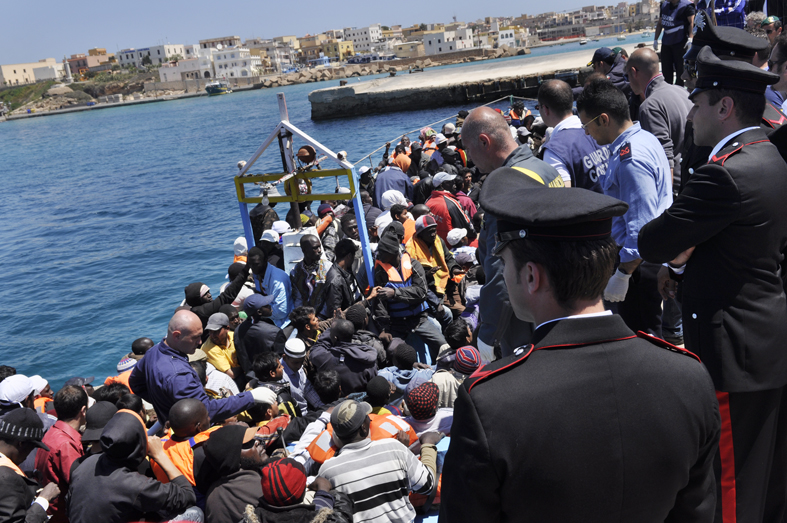
I had arrived on Lampedusa six days earlier on May 12. The following day a thousand refugees arrived in seven different boats embarked from Tripoli just over twenty four hours earlier. They were escorted by Italian coastguard and guardia di finanza vessels into the quayside where the media waited. A coastguard boss in wraparound shades counted them off, women and children first. Some who were suffering from heatstroke or dehydration were stretchered away by Red Cross staff. The rest passed between two lines of uniforms onto buses waiting to take them to the Welcome Centre five minutes’ drive away. Two men were led away by guardia di finanza officers. They would be the scafisti (the organisers of the crossing), an Italian journalist who had seen this all before told me. The total number on the boat and the date it arrived were spray-painted on its side. Then it was taken away to make room for the next. Around midnight on the following day I watched the operation’s completion at a different landing stage two miles from the town. The same buses which had spirited the migrants away to the Centre rolled up and stopped on another square of asphalt, this time bathed in artificial light opposite the entrance hatch of a huge ferry. Again the migrants’ path from bus to boat was flanked by lines of uniforms. They emerged in single file, men and women, each clutching a bag containing a bottle of water and a sandwich. They walked between the uniforms and up the gangway. Beside the hatch was the sign of Europe: yellow stars on blue. Many busloads later, before dawn, the Excelsior embarked on its journey to mainland Italy, where the refugees would be taken to other Centres to have their asylum claims processed. A wave of over one thousand people had been moved off the island less than forty eight hours after arriving. This transfer rate was now the status quo on Lampedusa. Whenever new arrivals meant that the Welcome Centre exceeded its capacity of around a thousand, a ferry boat came to take them away. Meanwhile, the ordinary, sleepy life of the island could carry on more or less undisturbed.
Six weeks earlier the situation was very different. This was late March, two months after revolution in Tunisia had sparked a mass exodus across the Mediterranean. Reporters were outdoing themselves to find new ways to describe scenes of chaos: the island was overrun; the Welcome Centre had exploded; it was a biblical emergency. The little hill above the port, an expanse of sun-bleached rock bare of all but hardy shrubs, had been covered with Tunisians huddled in makeshift bivouacs. For some weeks they outnumbered the five and a half thousand men, women and children of Lampedusa: a ravaged horde, mostly young males, with nowhere to go and nothing to do but wait. They had risked their lives for the dream of Europe and reached a limbo, neither here nor there. The nights were cold. They had no beds, no showers, and no toilets. They wandered across the island or walked into town and sat outside the bars on the main street, on the pavements, and on the public benches. The Lampedusans had never known anything like it. Migrants had been arriving for years but they were always kept apart in the Centre and eventually moved on. Anger boiled over. Protests were organised on the quayside. Impromptu blockades formed. Insults were hurled at fresh boatloads led in by the coastguard. “Go back!” “Our children must come first”. “No more immigrants”. “We’re full.” A BBC film crew captured these scenes, and the mayor Bernardino De Rubeis became the central figure in the resulting documentary: ‘The Invasion of Lampedusa’.
By May that degradation and hostility seemed a distant memory: the odd banner still hanging or slogan graffitied on a wall seemed to have nothing do with the people I saw moving about their daily lives. Only outside the town were there occasional glimpses of what it must have been like. The concrete shell of a half-constructed swimming pool still bore the evidence of a squatters’ camp: piles of clothing, blankets, food; dark patches where fires had been lit. In this place it was easy to imagine a thousand Tunisians squatting like shadows, the town centre with its tourist boutiques, bars and restaurants only a five minute walk away.
The climax to the emergency was the arrival of Silvio Berlusconi on March 30, the first time a President of Italy had ever come to Lampedusa. A convoy of forty cars led him from the airport to the town hall. After a short interlude he emerged onto the raised threshold: a familiar figure in a turtleneck and pale blue jacket, extra-diminutive beside the giant De Rubeis. “In forty eight to sixty hours”, he said, “Lampedusa will be inhabited only by Lampedusans.” The majority of the local crowd cheered, and continued to do so as he went on to outline promises of a year’s tax exemption, a nomination for the Nobel peace prize, and the purchase, by himself, for himself, of a villa on the island.
The villa deal now seems dead in the water (rumour has it there was too much noise from the airport runway). On pledges two and three the islanders are still waiting. But on the first, Il Cavaliere came at least close to keeping his word. Even as he was speaking, the first of six large boats was docking off the coast. After a delay of four more days, supposedly due to bad weather but also coinciding with the delay in ironing out the final details of a new repatriation deal with Tunisia’s interim government, these boats finally cleared Lampedusa. By mid-April the likeness to a refugee camp had all but disappeared. Now the locals just needed the tourists to start coming. What they got instead were refugees from an increasingly war-torn Libya, along with reporters who they felt did not make it clear enough that these arrivals could continue without damaging the island as a tourist paradise.
*
Giuseppina Nicolini manages the local office of Legambiente, a nationwide environmental body which takes an active role in protecting sensitive areas on the Italian territory. Since 2009 she has become one of the foremost voices opposing government policy on Lampedusa. I met her in her small office lined with bookshelves that threatened to spill their files onto the floor. She outlined an interpretation of the crisis of February and March pouring scorn on the mainstream view that the invasion of Lampedusa was an unfortunate but inevitable by-product of unprecedented events in North Africa. For her the hysteria about a ‘biblical emergency’ ignored the historical fact that Lampedusa had been dealing with mass migration for years, and that between spring and autumn 2008 migrants had arrived at an almost comparable rate. There were 33,000 arrivals in the whole of 2008, most of them concentrated in a six month period; by mid-May of 2011 it was estimated that around 30,000 had arrived since the start of the year. “I don’t want to play down what has happened – what’s still happening – in North Africa, which is of historic importance, but it shouldn’t mean we put slices of ham over our eyes… It’s just the reopening of a route that the deal with the bloodthirsty, mad dictator, Gaddafi, had closed.” (Since spring 2009 until the Libyan revolution Italy had a joint coastal policing deal with Gaddafi which involved migrant boats being turned back to Libya on the high seas before they could make an asylum claim, a policy known as respingimenti)
“At a certain point migrants kept arriving but they didn’t leave any more… And if instead of taking them away you let them build up and build up and build up, it’s obvious that you’ll get to seven thousand – actually more – after a certain point they stopped giving the true number because it was too dangerous, it would have spread panic… What happened was a thing of indelible, unforgettable shame, thousands of human beings treated worse than animals.” Nicolini made the point that in 2008 the Welcome Centre model coped because the transfers off Lampedusa to mainland Italy kept happening. And this year? She was coming to that. The oft-repeated argument that the Centres on the mainland were full was rubbish: “They (the government) were quite explicit about the fact that they wanted to keep them (the Tunisians) here until repatriation… because when it was found out that the regions had space for 50,000 and there were 12,000 Tunisians – at that point 5,000 of them here – a Government senator was asked on live TV what they were waiting for to take those 5,000 off the island. And he replied ‘But the 50,000 places are for refugees. They’re Tunisians, they’re not refugees. They have to be repatriated. And so we’ll keep them there (on Lampedusa) because from there they can’t escape.’”
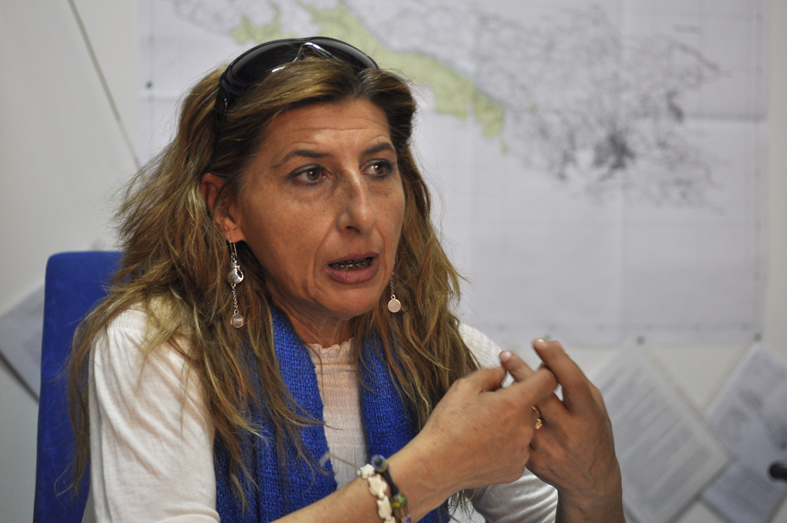
Nicolini paused for breath. Did we mind if she smoked? She opened the window a crack, drew on the cigarette, and continued. The mayor Bernardino De Rubeis, did not escape her attack: “He – his administration – was the condition sine qua non that allowed the government and Minister Maroni to carry out this scandalous piece of political propaganda.” Again, she said, a historical perspective was required to understand this. Since mid-2009, despite the respingimenti and repatriation deals with Libya and Tunisia, some boatloads of migrants had continued to slip through the net. Rather than being processed in the Centre they were put up in hotels and taken off the island discreetly by plane. This was all so that the Italian Interior Minister Roberto Maroni could show an empty Centre to visiting officials and journalists as evidence that the government policy was working. De Rubeis’ local administration was fully aware of the charade – they helped organise it. Then from February 9, two weeks after revolution in Tunisia, the Italian government made a decision to stop taking Tunisians off Lampedusa. As boatloads continued to arrive, there were to be no more hotel stays either. And not only that: for a short time the one facility on the island equipped to house them was off limits too: “For three days people arrived, arrived, arrived, and none were allowed into the Centre. They were left outside because the Centre was not to take in migrants. Maroni said it was closed. That wasn’t true. It was staffed and operational. But Maroni said it was closed. And the mayor repeated: ‘the Centre must remain closed’ (a video interview posted on youtube by a local film-maker shows De Rubeis worrying that “an open centre is an invitation to come”)… And still there was no sign of the press, the TV, the NGOs. We were the only ones trying to cry out what was happening… He (the mayor) had the power to open the Centre, even against the will of the Minister, because at a certain point, when there are five thousand people roaming the streets, there’s also a problem of hygiene, of public health… and so, if a facility exists, why not open it?” In the end the Centre was only opened on the evening of February 13, the day after TV cameras arrived.
This account was confirmed by Alexandre Georges, a French human rights campaigner who had been on Lampedusa documenting events since November 2010. Georges was preparing for a one-man sea kayak voyage first to Tunisia and then to Brussels, via the Italian coast and the French river network. Along the way he intended to collect signatures for a petition highlighting the migrants’ plight, which he would present to the European Commission at the end of his trip. Like Nicolini, he was disgusted by the way Italy had washed its hands of the Tunisians, and sure that Lampedusa was always meant to spiral out of control: “There was a sense of panic among carabinieri in the days following the 9th (of February) as if they didn’t know what was going on”. He said that after the Centre opened on February 13 the authorities did take some Tunisians away, so by the end of the month the streets were nearly clear. But then, from early March, departures ceased again and the second, even larger wave of the emergency built up. That was when the BBC crew came to film, making Bernardino De Rubeis the pivotal figure in their documentary.
Despite his best efforts to appear in control, the documentary made it clear that De Rubeis was struggling in the face of rapidly evolving chaos. He was desperate to minimise discomfort to both locals and migrants, even hosting Tunisian women and children in his own holiday villas. But for the most part he was helpless. One scene showed him striding among Tunisian squatters in the Stazione Marittima, pleading for someone who understood Italian so that he could tell them to clear up the rubbish. In another he stood on the quay alongside locals protesting against what they saw as the Italian government’s deliberate abuse of Lampedusa, and attempting to stop a boat from unloading sanitary equipment. Suddenly De Rubeis seized a loudhailer and began telling them they had to let the boat dock after all. This and other evidence suggested that De Rubeis had spent the best part of two months trying to maintain his grip on two incompatible roles. In one he was the indignant voice of the islanders and migrants; in the other he was the not-quite invisible hand of the government.
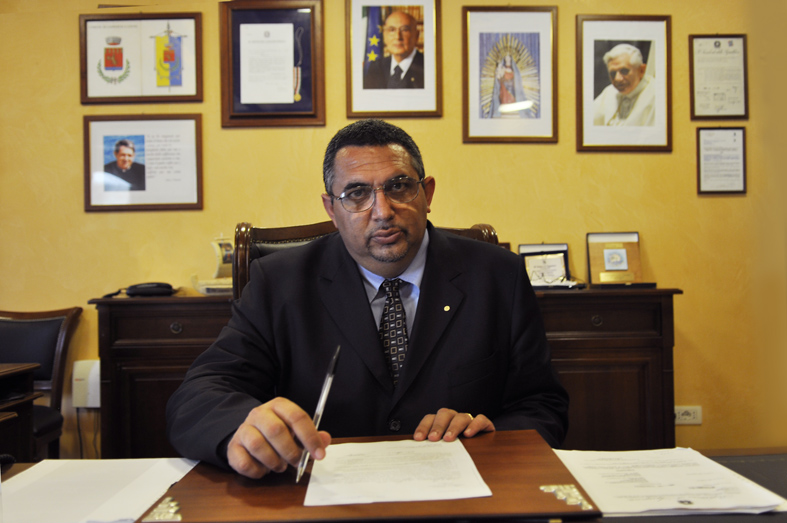
I interviewed him in his well-appointed office in the town hall, gilt-framed portraits of the President of the Republic, the last Bourbon King of Sicily, and the Pope behind his desk. I barely finished the question (was he satisfied with the government’s response to the crisis) before he launched into a monologue – or rather a series of tortuously interlinked clauses – which turned out to be somewhere between a confession and a justification of all that Nicolini accused him of:
“I have to tell you, with great tranquillity, this: that Lampedusa – the people of Lampedusa – gave themselves to this humanitarian crisis – and I refer to the Tunisians who were present for fifty eight days – that the people gave themselves, collaborating with central government, in order that this emergency, this problem of an uneasy welcoming on the part of an absent Europe – with the spotlight on this little island – could bring forth out of Lampedusa, but above all out of Italy, a strong message of the crisis that all the member states of the European Union should absolutely be taking on board.”
Before I had time to untangle that forkful of syntactical spaghetti he began a fresh one, reiterating the point:
“If Lampedusa had not allowed itself to be invaded for about two months the problem would definitely not have got out of Lampedusa, because if you have 6,300 immigrants in a territory like that of Lampedusa, with a resident population of 5,800, it is very different from sending those 6,300 immigrants to Italy where nobody notices because Italy is big, and so, almost deliberately, a tragic moment was created so that Europe would wake up to the problem. I am convinced of this and I take responsibility for it, because the government, as it is doing today, and as it did after fifty eight days of the crisis, could have easily and quickly resolved the problem by transferring the immigrants to the various centres in Italy. Many are full, but they could have created more…”
De Rubeis admitted in other words to being fully aware that the Italian government could have moved the migrants if it had wanted to, and that Lampedusa had been used a propaganda tool to attract the attention of Europe. He was not ashamed of the fact. To him it was a price worth paying. Throughout the interview he returned again and again to the theme of suffering – human and economic – and the justifications for it. He insisted he could have done nothing else; that the emergency was not, as Nicolini said, a cynical ploy, but necessary for the greater good. There was no mention of a change of mind. It was as if a different man had told a Sicilian TV channel on March 15: “The current situation is critical. The government must immediately organise flights to transfer these young immigrants to Italy… it is unthinkable that Lampedusa can become a refugee camp.” When I asked why he had invited French and Italian far right politcians to Lampedusa at the height of the crisis, his response suggested a reason for the apparent contradictions in his stance: “We have to distinguish between Dino De Rubeis the person, who is Lampedusan, born here and lives here, and Dino the mayor, who represents these people, who for five years has been trying to serve his people…” “Being mayor,” he declared, “means having a duty to welcome everyone.” On March 30, as Berlusconi’s cavalcade approached the town hall, De Rubeis told the waiting locals to take down banners which might anger the Premier: “It is not the time for politics,” he said then. Now, a month and a half later he told me that the time was right to exert political pressure, and that he was the man to do it:
“On May 16 I’ll go to Rome to try to meet Berlusconi because what do the people here need? Or rather what does the tourism sector need? They need serious answers… a ten year run of credit, which can be given by the Sicilian region… and on the national level what do they need? A block on taxes for at least six to seven months…”
To Giuseppina Nicolini no such financial rewards, even if they are obtained, could justify the use of Lampedusa as a propaganda vehicle. She saw Italy’s appeal for European sympathy in dealing with the Arab Spring as no more than opportunism. “Germany has 400,000 refugees. Italy only 40,000. Countries smaller than Italy have seven, ten times more refugees…” But it was the use of the crisis for stirring xenophobia that disgusted her even more: “Why else did they do it? To show to everyone: look what happens when a place is invaded by North Africans. Well, dammit, you try taking an island this small and doubling the population with people who don’t have anything at all…” She was in no doubt as to who was responsible. Rather than Silvio Berlusconi or his Popolo della Liberta (People of Freedom) party, the chief instigators were his coalition partners in the far right Northern separatist movement, the Lega Nord. The Lega in recent years has changed; from being mainly an anti-Southern party, it now directs its most virulent rhetoric against immigrants while trying to spread its appeal across Italy with the message that federalism would benefit all regions. Anger against a perceived betrayal by the European Union has become a cornerstone, with Lega party literature declaring that the E.U. should continue to exist but in a radically changed form, reflecting Europe’s ‘Christian roots’. At the height of the crisis their leader, Umberto Bossi, came out with the popular soundbite immigrati fora dai ball, a Northern dialect phrase which roughly translates as ‘Immigrants get the f*** out’. The makeup of the Italian Parliament since 2008 means that Berlusconi’s government depends on Lega support to pass legislation. In return the Lega has been able to exert a strong influence including obtaining ministerial positions. Interior Minister, Roberto Maroni, is a Leghista.
“The Lega needed to show their voters in the north this monster of Lampedusa. It was a well-designed plan, and from their point of view it worked perfectly. On an island it’s easy. It’s a sealed environment. You can truly do whatever you want.”
*
The mainstream media has hardly mentioned that the 2011 crisis had an aborted dress rehearsal two years earlier. This happened at the beginning of 2009, when any notion of an Arab Spring seemed impossible. The cause then was not war and revolution, but the fact that the migrant influx was not at that stage regulated by agreements with the dictators Ben Ali and Gaddafi. The latest in a series of repatriation accords with Tunisia was on the rocks. Talks with Ben Ali were ongoing but nothing had yet been sealed. The Libya respingimenti deal was still waiting to be ratified by the Italian Parliament. Just as would happen two years later, pressure on Berlusconi to halt the flow of migrants onto mainland Italy reached a head. As in 2011, it was pressure that came mainly from the Lega.
On January 23 2009 Maroni announced that the Welcome Centre on Lampedusa would henceforth operate alongside a ‘Centre for Identification and Expulsion’ (CIE). The Lega had made their intentions clear: they wanted to redefine Lampedusa not as a stepping stone but as a place where migrants could be kept until being sent back whence they came. Negotiations to ratify the Libya deal and make a new agreement with Tunisia were at a critical stage. There was an obvious benefit to creating a situation on Lampedusa that would sting previously reluctant hands into action. The pace of transfers off the island slowed and numbers in the Centre swelled far beyond its eight hundred capacity. On January 24 more than one thousand broke out of the gates and with the apparent acquiescence of the police made their way peacefully to the town hall, where a crowd of locals protesting against the planned CIE greeted them with cheers. It was a moment of solidarity; locals and migrants united in their refusal to allow Lampedusa to be turned into a prison island. Bernardino De Rubeis was with them: “Lampedusa is not for sale. We find ourselves confronted with an all-powerful state that wants to impose its own choices and transform this island into a prison under the open sky.” The government’s immigration policy had, he said, “revealed itself to be a failure”. For daring to speak out against Maroni’s plans, he became the target for direct attacks. Leghista Minister Roberto Calderoli, accused him of deliberately seeking the spotlight and “throwing petrol on the fire”. This was the same Calderoli whose speeches to Lega supporters included lines such as: “the door is always open for them to go back to the desert and talk to camels, to the jungle to talk to monkeys.” From the Tunisians’ perspective the protests solved nothing. Following a new deal with Ben Ali, repatriations soon began again. When they learned what was happening, small groups inside the Centre began hunger strikes and self-harming in protest. On February 18 2009 the Centre was almost destroyed in a riot, causing a fire that sent toxic fumes across to the nearby town. Still De Rubeis reserved his ire for the government and the Lega’s influence within it: “They have turned the Centre into a concentration camp. The immigrants are at the end of their tether.”
But Maroni and Calderoli were not without allies on Lampedusa. One of the stranger features of the island’s recent history is that the Lega, with its northern separatist agenda, has successfully managed to implant itself there, on Italy’s southernmost point. Two of its candidates won council seats in the last local elections in 2007. One of them, Angela Maraventano, became De Rubeis’ deputy-mayor in a ‘centre-right’ coalition. De Rubeis himself was affiliated to the Movement for Autonomy – a southern-based party which campaigns for greater federalism but without the Lega’s intrinsic racism. The following year, still holding the post of deputy mayor, Maraventano was put forward in a northern seat for elections to the Senate, the second chamber of the Italian Parliament. Her successful election capped a speedy rise onto the national political stage. In return, the Lega expected her to take the battle to Lampedusa. She did not let them down. To a backdrop of public abuse she spoke in defence of the government at the same January 2009 protest where De Rubeis delivered his message of defiance. The schism between mayor and deputy deepened in March when the government hurriedly converted a former NATO radar post into a Centre for Identification and Expulsion. Claiming Maraventano had gone behind his back, he sacked her. Two months later the CIE was dismantled after De Rubeis led arguments that it had been constructed illegally. At this point there seemed to be no doubt that if the Lega – and the government – wanted to use Lampedusa as Italy’s immigration Alcatraz, they would find in Bernardino De Rubeis a genuine block of resistance.
That ceased abruptly on July 21 2009, when officers of the guardia di finanza descended on Lampedusa, arrested the mayor, handcuffed him, and took him by helicopter to prison in Agrigento on Sicily. He faced charges of bribery and corruption related to his mayoral role. From the beginning De Rubeis has denied the charges. Initially he claimed his arrest was a political plot by the government to punish him for his opposition. He was kept in jail for a month before being released pending trial. 2009 turned into 2010 and still the trial had not begun. In February 2010 he sent a letter to Interior Minister Maroni – a letter which subsequently became public – congratulating the Minister for the success of the respingimenti policy and offering one of the most humbling political apologies that can surely ever have been tendered to a former enemy: from a stubborn man, but a man able to understand when the time is right to take one or more steps back, recognising the merit and courage of someone who, with a strong, decisive action, has pulled off a masterplan. Simultaneously he posted an official ordinance reinstating Angela Maraventano as his deputy with special responsibility for immigration: …in the hope that she will forgive an old friend guilty of not defending and supporting a woman who was able to foresee the grand political design which has saved our island. And continuing: The senator Maraventano is a worthy daughter of this land and we know that her heart is capable not only of forgiving but of continuing to work for rebirth…
To an extent it would be unfair to accuse Bernardino De Rubeis of hiding his supporting role in the 2011 emergency. In the matter of immigration, his collaboration with the government and the Lega on Lampedusa was signed and sealed. Effectively from the date of his prison release at the end of August 2009, there is no evidence that the old defiant mayor still existed.
“Someone easily blackmailable,” was Giuseppina Nicolini’s carefully worded assessment of the mayor. Not that she believes the charges against De Rubeis are trumped up: the Legambiente was one of several interest groups who recently presented a two hundred page dossier to the regional prosecutor detailing his alleged abuses of office. But there was more than a hint of sympathy in her voice when she said “in a way he is both victim and executioner in this affair: executioner of his subjects; victim of his superiors.”
When I asked him about his trial, which was then finally being heard in sessions separated by long intervals in the courthouse of Agrigento, he no longer held the government responsible. On that score too he had changed his mind. The enemies now were closer to home: the bureaucratic classes who, for years, he said, had enjoyed things their own way on Lampedusa:
“The problems start when someone wants to make changes – when there are monopolies, when so often it’s the white collars who decide things, and then a mayor comes in – a mayor of the people, a mayor who is the son of a fisherman…”
The laments of Bernardino De Rubeis were many. Where Nicolini guarded against despair with irony and cigarettes, he turned to history and the knowledge that his fate as an Italian politician forced into compromise was nothing new:
“Very often the people choose a man to govern them, and then this man who should be able to govern peacefully finds himself caught up in situations where he is forced into agreements and compromises which mean that he cannot do his duty and honour the faith the people placed in him.” This was one of the few moments where De Rubeis’ syntax briefly untwisted and flowed naturally, even if the meaning was open to multiple interpretations. Was it an oblique admission that his radical U-turn from opposition to support for government policy on Lampedusa was somehow connected to the events surrounding his arrest and trial? Or was it simply a general statement, that it was impossible for a local leader to represent the interests of his people when the will of certain influential figures was against him. Either way it seemed to summarise the heart of the story. Behind a painted tableau of crises and heroes lay the faded scenery of local democracy battered and eroded by the cold exercise of power.
 T.Y. Garner Writer